Continuity — Belgian M&A Marketplace
Context
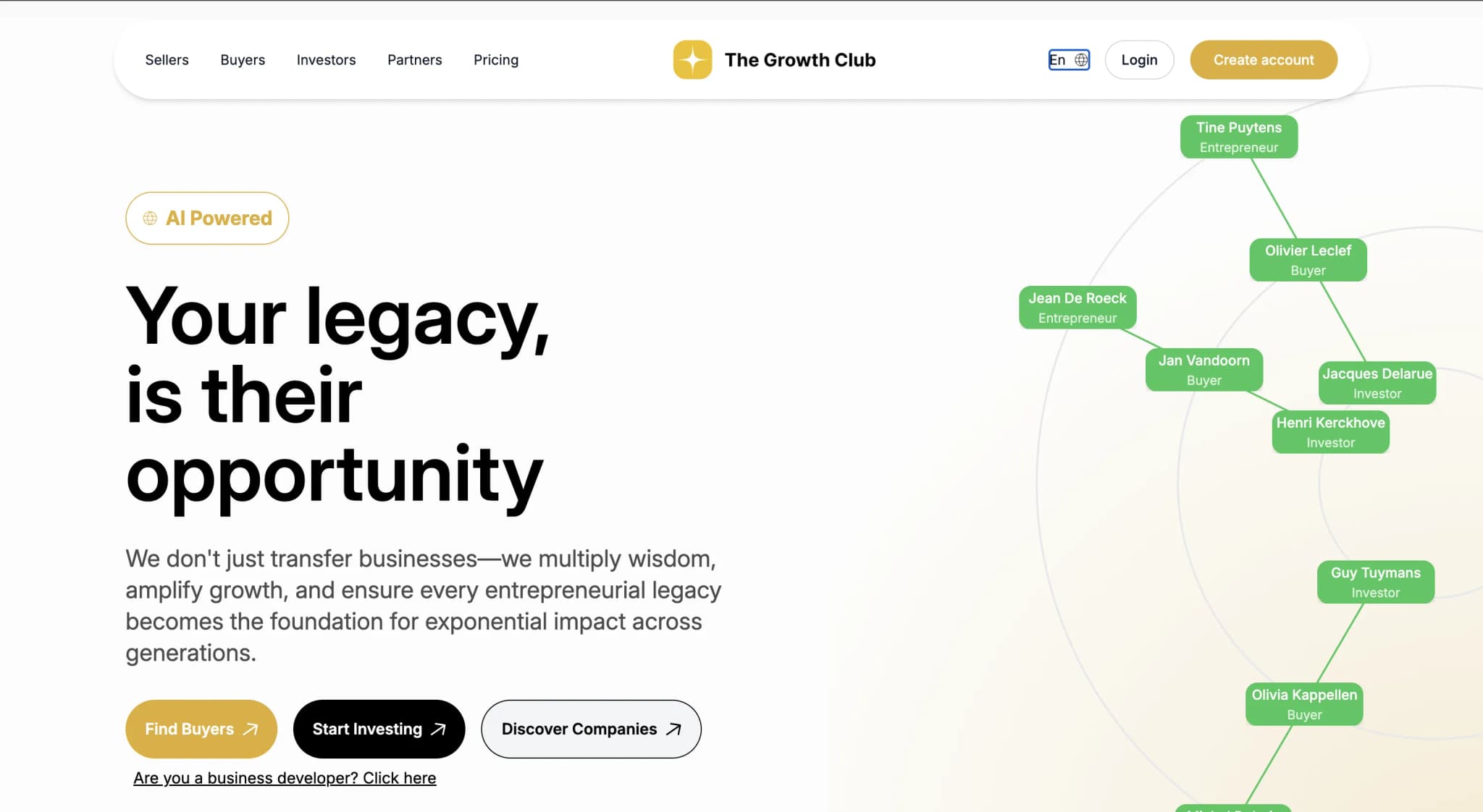
Continuity (launched as The Growth Club, later rebranded) is a marketplace for buying and selling Belgian SMEs — the first platform of its kind in the Belgian SME market. It takes the M&A process online end to end: discovery, matching, NDAs, and the dataroom.
The Hard Part
M&A participants have sharply different rights to see deal information, so access is governed by 5 roles across 6 tiers — with digital NDAs and an OCR dataroom handling sensitive documents, in 3 languages.
What I Built
- Claude-powered matching engine pairing buyers with businesses for sale
- OCR dataroom for deal documents
- Digital NDA flow
- Role and tier system: 5 roles across 6 access tiers
- Integrations with 4 registry APIs
- Trilingual experience across 3 languages
The Build
The fact that a business is for sale is itself sensitive
Selling a company is not like listing a property. With a house, publicity is the objective — the more people who know, the better the outcome. With a business, the same information is dangerous. If staff learn the owner is selling they update their CVs, if customers learn it they start talking to alternatives, and if competitors learn it they use it. The value being sold can be damaged by the process of selling it.
So an M&A marketplace cannot simply publish listings. It has to manage disclosure as a sequence: enough detail to attract genuine interest without identifying the company, then progressively more as a counterparty proves they are serious, and the full picture only to someone who has committed to confidentiality. Taking that process online end to end — discovery, matching, NDAs, and the dataroom — means encoding each of those stages as something the software actually enforces.
This is why the access model is the product rather than a feature attached to it. In most platforms permissions protect the system; here they are the thing being sold. A marketplace that cannot reliably control who sees which layer of a deal is not a marketplace with a security weakness — it is one no seller can use.
Two questions that are not the same question
Access is governed by 5 roles across 6 tiers, and the reason it is a matrix rather than a longer list of roles is that it answers two independent questions.
The first is who somebody is — their relationship to the transaction, which determines the kind of information relevant to them at all. The second is how far into a particular deal they have been admitted, which changes over time as trust is established. Those vary independently: two people in the same role can sit at completely different depths on the same deal, and the same person can be deep in one transaction and at the outer edge of another. Collapsing them into a single dimension would mean inventing a new role every time a legitimate combination appeared.
Because M&A participants have sharply different rights to see deal information, that matrix has to be enforced everywhere rather than at the surface. The dataroom is the obvious place, but OCR makes documents searchable — which is genuinely useful and is also a second surface where access control must hold. A search result that reveals the existence of a document, or a phrase from inside it, has disclosed something regardless of whether the file itself could be opened.
Being the first platform of its kind in the Belgian SME market removes the usual shortcut here. There was no incumbent whose workflow could be studied and improved on, so the sequence of stages, the boundaries between them, and what each participant sees at each point had to be designed rather than inherited.
Belgium adds a further requirement that is easy to underestimate: a trilingual experience across 3 languages is a condition of operating in that market rather than a localisation nicety. In a domain where the precise meaning of a document matters, language coverage is not decoration.
Making the legal step and the software step the same event
The digital NDA flow is the mechanism that connects the two halves. In a traditional process the confidentiality agreement is a document exchanged separately, after which somebody manually decides what to send next — the legal act and the information release are different events, separated by a person and a delay. Making the NDA a step inside the platform means signing it is the transition: the moment the agreement completes, the tier changes and the next layer becomes visible. There is no window in which someone has signed but not yet been granted access, and none in which they have access without having signed.
The OCR dataroom turns deal documents from files into content that can actually be worked with. Diligence involves reading a large volume of material to find specific facts, and searchable documents are the difference between a dataroom that supports that work and one that is merely a folder. The corresponding obligation is that every search runs inside the same tier boundary the documents themselves respect.
The Claude-powered matching engine addresses a problem that keyword search handles badly. Whether a buyer fits a business for sale is a qualitative judgment — sector, scale, and situation interact, and the criteria that matter are described in prose rather than selected from dropdowns. It is also the step where confidentiality and usefulness pull against each other, since matching has to reason about details that cannot yet be shown to the person being matched.
Integrations with 4 registry APIs anchor listings to official records rather than to what a seller says about their own company. In a market where a buyer is being asked to trust an anonymised profile before they can verify anything themselves, independent data is what makes the early stages credible.
Reading the numbers
Most of the figures here describe the disclosure model rather than volume, and that is the right way to read them. 5 roles and 6 tiers is the shape of the confidentiality system — the thing sellers are actually buying. 4 registry integrations is the breadth of independent verification behind listings. 3 languages is market access in a country where that is a precondition rather than a feature.
Being first of its kind in the Belgian SME market is the claim that stands apart, because it is a market position rather than a measurement. Its practical significance is what it cost: every workflow, every boundary between tiers, and every decision about what a participant sees at each stage had to be worked out from the domain instead of copied from something already operating. The platform is live at continuity.deals, which is the part a reader can check for themselves.
Measured Results
First
platform of its kind in the Belgian SME market
5
user roles
6
access tiers
4
registry APIs
3
languages
Tech Stack
More Case Studies
Have a similar project?
I would love to help you build something great. Let's discuss your requirements.