HomeBrigadier — UAE Services Marketplace
Context
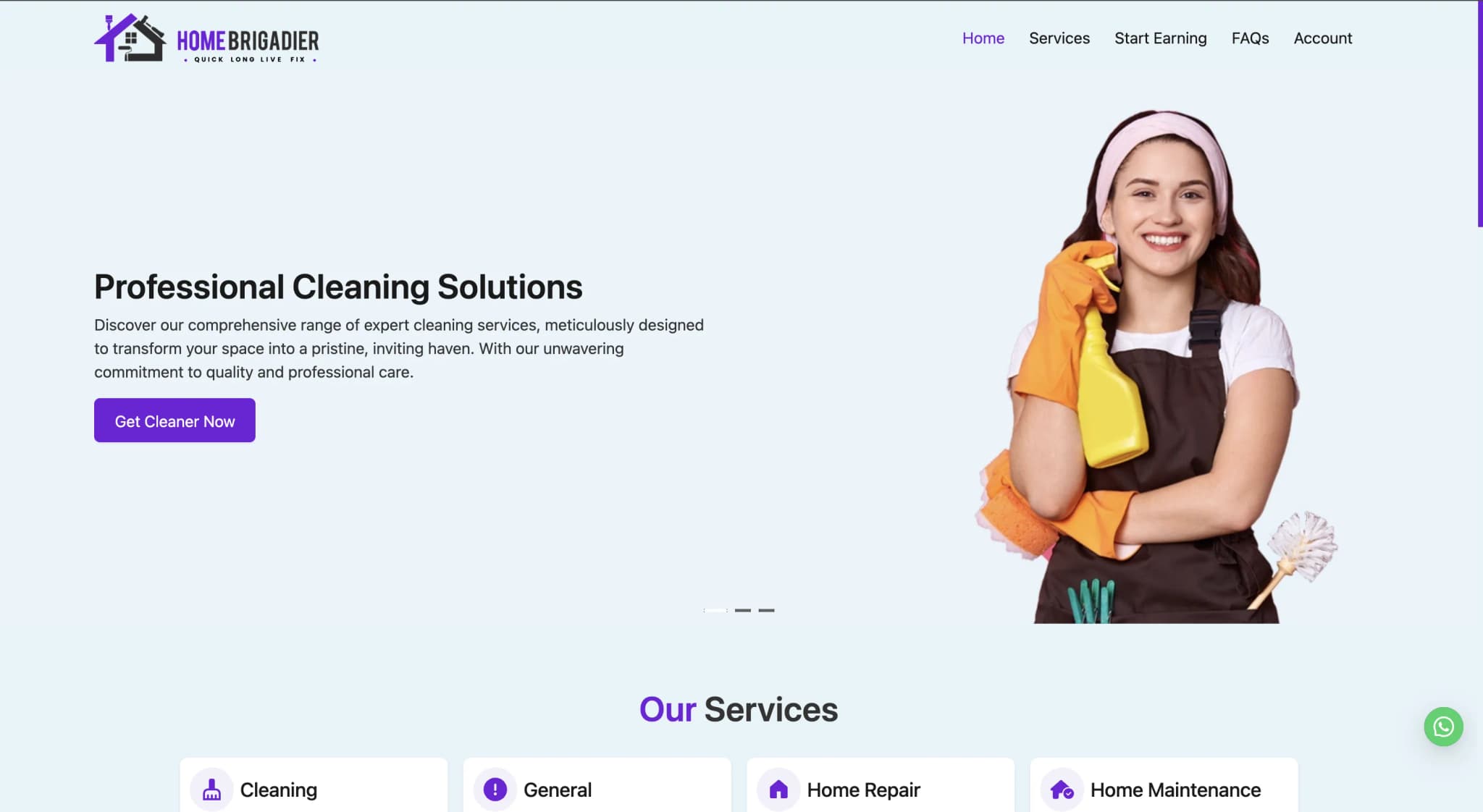
HomeBrigadier is a home-services marketplace for the UAE, connecting homeowners with verified providers across 21 service categories. Booking, payment, and provider management all happen on-platform.
The Hard Part
Existing options lacked real-time availability, transparent pricing, and provider accountability — the marketplace had to deliver all three while keeping bookings flowing reliably on both sides.
What I Built
- Marketplace covering 21 service categories
- Real-time booking flow with availability checks and instant confirmation
- Stripe payments with automated provider payouts
- Provider dashboards for scheduling, earnings, and client communication
- Verified provider network with ratings and reviews
The Build
Three complaints with one cause
The gaps in existing home-services options were real-time availability, transparent pricing, and provider accountability. Listed separately they look like three features to add. They are better understood as three symptoms of the same condition: the transaction was not happening on the platform.
Follow each one and it ends in the same place. Without live availability a homeowner cannot book, so they call — and the arrangement is now a phone conversation the platform knows nothing about. Without transparent pricing the price is negotiated in that call. And without a record of what was agreed, when it happened, or whether it was completed, accountability has nothing to attach to; a rating means very little when the job it refers to exists only in two people's memories.
That is why booking, payment, and provider management all happen on-platform. It is not three features bundled for convenience — it is the single decision that makes the other three possible, because a marketplace can only guarantee what passes through it.
What made it hard on both sides
A marketplace fails asymmetrically, and the two sides fail differently. A homeowner who has a poor experience leaves quietly and is difficult to win back. A provider whose calendar stays empty leaves too, and takes supply with them — which degrades the experience for every homeowner who arrives afterwards. Keeping bookings flowing reliably on both sides is one requirement, not two, and neglecting the supply side is the more expensive mistake because its damage compounds.
Breadth was the second pressure. Twenty-one service categories do not share a shape. Work varies in duration, in how it is priced, in how much notice a provider needs, and in whether a job is a single visit or something recurring. A booking model built around one category and stretched to the others produces a system that is awkward everywhere and correct nowhere, so the model has to generalise from the start.
Instant confirmation is the third, and it is a much stronger commitment than it sounds. Confirming immediately means the platform is asserting, at that moment, that a specific provider is genuinely free — so availability has to be live state rather than a stale copy, and two homeowners booking the same slot at the same time has to resolve correctly rather than optimistically.
How the pieces fit
The real-time booking flow is what converts an enquiry into a commitment. A request form asks a provider to respond; a booking with an availability check and instant confirmation tells a homeowner the job is arranged before they close the tab. That difference is the product, and it is also what makes every downstream guarantee possible, because the platform now holds a record of exactly what was promised to whom.
Payments on-platform through Stripe, with automated payouts to providers, is the piece that gives accountability teeth. If money moves off-platform the marketplace loses its only lever — it can display a rating but it cannot do anything about a dispute. Handling the payment means the platform is party to the transaction rather than an introduction service, and automating the payout side means providers are paid without either party chasing it, which removes the most common reason both sides start arranging things privately.
Provider dashboards covering scheduling, earnings, and client communication are the supply-side retention work, and they matter more than their prominence suggests. Providers stay where they can see their income, manage their own time, and talk to clients without leaving the system. Every one of those is also a reason not to take the relationship off-platform, which protects the record the entire accountability model depends on.
Verification, ratings, and reviews then complete the loop. They are only meaningful because the bookings they describe are ones the platform actually processed — a review attached to a job the system confirmed, paid, and closed carries information that a review attached to an unverified claim does not.
What the numbers say
Twenty-one service categories is the evidence that the booking model generalised rather than being fitted to one type of work. Breadth like that is where marketplace software usually reveals it was designed around a single happy path.
The 90% completion rate is the figure that matters most, and it is easy to walk past. Bookings created is a vanity number; bookings completed is the marketplace working. Every failure between those two states is a homeowner who arranged something that did not happen and a provider who lost a slot — the exact experience that sends both sides back to phone calls. A completion rate that high is what makes the on-platform argument credible rather than theoretical.
100 providers and 2,000 bookings describe a network being used rather than merely populated, which is the harder of the two things to achieve. Supply that exists but sits idle is a marketplace that has not started yet.
99.9% uptime carries specific weight for time-bound transactions. A homeowner who cannot book when they need someone does not wait for the platform to recover — they call somebody, and that booking is gone along with the record it would have created. For a system whose central argument is that transactions belong on-platform, being available is not an operational statistic but a precondition for the argument holding.
Measured Results
21
service categories
100
providers
2,000
bookings
90%
completion rate
99.9%
uptime
Tech Stack
More Case Studies
Have a similar project?
I would love to help you build something great. Let's discuss your requirements.