Chasr — AI SalesTech Platform
Context
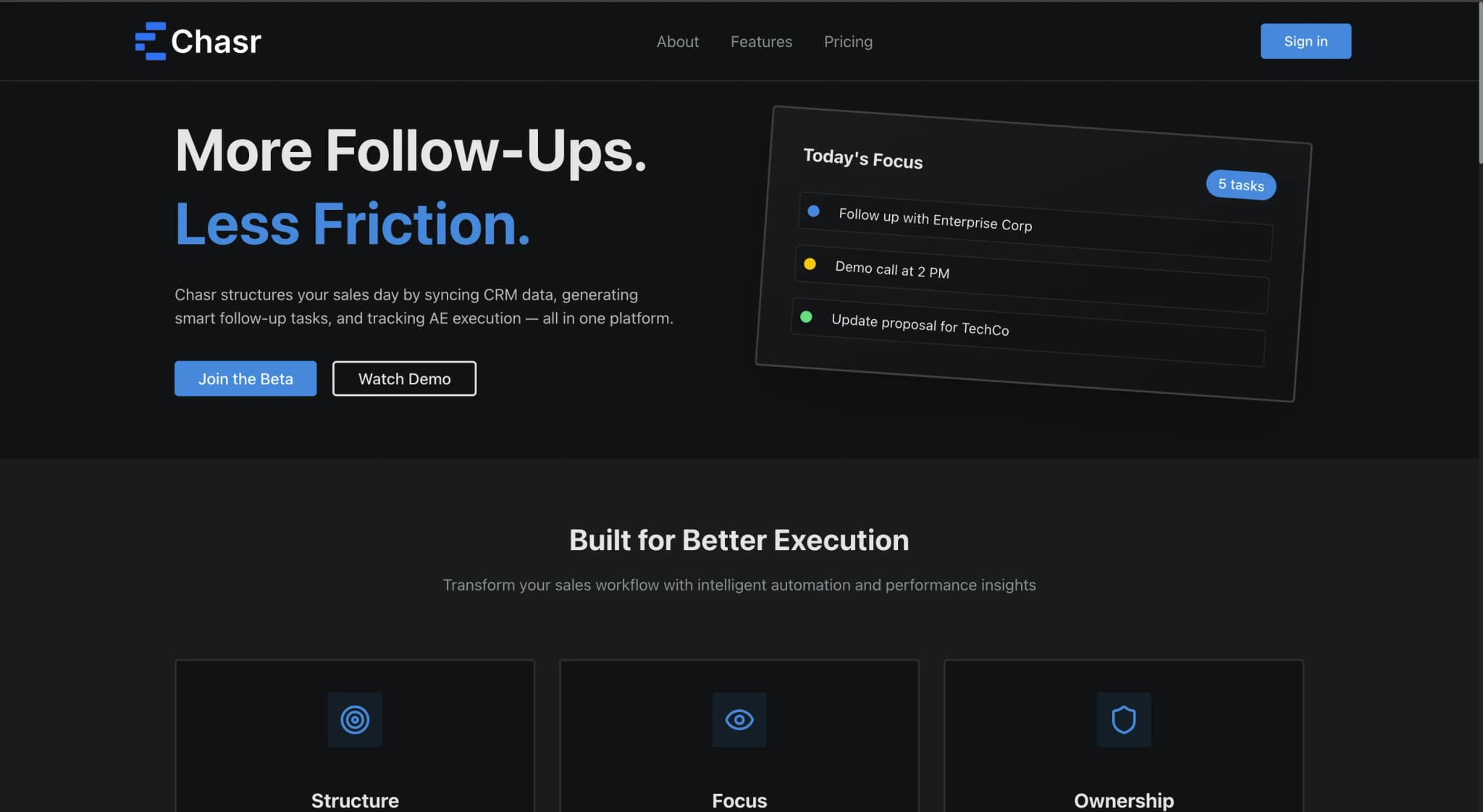
Chasr puts an AI layer over a sales team's pipeline so reps spend their hours selling instead of on manual follow-up work. It plugs into HubSpot rather than asking teams to change CRMs.
The Hard Part
Sales reps abandon tools that add friction, so the platform had to fit inside existing HubSpot workflows and prove its value in recovered hours rather than another dashboard to check.
What I Built
- GPT-4-powered follow-up assistance for sales reps
- HubSpot CRM integration
- React front end and Node.js services powering rep workflows
- Onboarding flow that brought 50+ reps onto the platform
The Build
Deals are lost to silence, not to competitors
Follow-up is the highest-value work in a sales pipeline and the easiest to postpone. A rep knows which deals need touching. What they do not have is a forcing function, because a follow-up has no deadline of its own — it competes against live conversations, inbound requests, and meetings that are happening now, and it loses that contest every single day it is allowed to.
What makes it corrosive is that the cost is invisible. A deal lost to a better competitor produces a reason someone can learn from. A deal lost because nobody wrote the third email produces nothing at all — it simply goes quiet, drops out of the forecast, and is recorded as the market being difficult. No one reports the follow-up they did not send.
So the target is not a smarter pipeline view. Reps already know what needs doing; the pipeline told them. The problem is the distance between knowing and doing, which is measured in the minutes it takes to write something specific to a deal after a day of other work.
Why the tool had to be almost invisible
Sales reps abandon tools that add friction, and the reason is that they are measured on quota rather than on tool adoption. Any product asking for ten minutes of input has to return more than ten minutes of value that same week, visibly, or it is quietly dropped. Nothing forces a rep to persist with software that has not yet proved itself.
That rules out the shape most of these products take. Another dashboard to check requires the rep to go somewhere and look at something — a new habit, competing with the habits that already pay them. Value has to arrive inside the workflow that exists rather than waiting in a place they have to remember to visit.
Plugging into HubSpot instead of replacing it follows directly. Changing CRM is an organisational project with data migration, retraining, and a period where everyone is slower; integrating with one is a decision a sales leader can make without a committee. It also means the platform is a guest in someone else's data model — HubSpot holds the truth, imposes its own object shapes and rate limits, and can be changed by users at any moment without telling you.
Adoption across a team is the constraint people underestimate. A tool loved by five enthusiastic reps and ignored by the rest produces no measurable outcome, because sales metrics are team-level. Getting to 50+ reps means onboarding is not a login screen at the edge of the product — it is a feature the result depends on.
Where the AI actually sits
The split that matters is between what is slow and what is fast. Deciding whether to follow up, and judging whether a draft is right for this particular buyer, takes a rep seconds — that is expertise they already hold. Producing the draft in the first place is what takes the time, and it is the part that gets deferred at five in the afternoon.
So GPT-4 handles drafting and the rep keeps the judgment. Giving someone something specific to react to rather than an empty field is the whole mechanism: editing a draft that already references the right deal is a fundamentally different task from composing from nothing, and the difference between them is most of the ten minutes that was stopping the message being sent.
That also sets the accuracy bar correctly. The output is not sent automatically, so a mediocre draft costs a few seconds of editing rather than a damaged client relationship — which means the system can be useful well before it is impressive. A product that required the model to be right unattended would have to be far better before it could be used at all.
The HubSpot integration carries the context that makes drafts specific, and it has to respect the CRM as the system of record. Writing back has to fit what HubSpot expects rather than fighting it, because a tool that leaves a rep's CRM in a state their manager does not recognise has created work rather than removed it.
What the numbers measure
10 hours saved per rep per week is the figure the whole design was aimed at, and it is stated in exactly the unit the constraint demanded — recovered hours rather than dashboard engagement. It is also the number that answers the adoption question, because ten hours is far past the threshold where a rep decides a tool is worth the friction of using it.
The 60% increase in follow-ups is the behavioural change that makes those hours worth anything. Time saved matters only if it converts into activity that produces pipeline; the two numbers are one result reported from opposite ends, and either alone would be much weaker evidence.
$100K+ in capacity recovered per quarter is the same story in commercial terms, and worth reading precisely: it describes recovered selling capacity rather than booked revenue. That is the honest framing — the platform returns hours and increases follow-up activity, and what a sales team converts that into is their work rather than the software's claim.
50+ reps onboarded is what makes the per-rep figures meaningful at all. A ten-hour saving demonstrated on a handful of enthusiasts proves very little; the same result across a team of that size means the onboarding flow did its job and the tool survived contact with reps who had no particular interest in trying it.
Measured Results
50+
reps onboarded
10 hrs
saved per rep per week
+60%
follow-ups
$100K+
capacity recovered per quarter
Tech Stack
More Case Studies
Have a similar project?
I would love to help you build something great. Let's discuss your requirements.